Growth feels good.
More orders.
More customers.
More revenue.
However, growth also brings pressure.
This is Ravi’s story. He runs a growing manufacturing and distribution company. His journey reflects what many SME owners experience when their systems stop keeping up.
If you are looking for ERP for SMEs, ERP implementation for manufacturing, or an ERP readiness assessment, this will sound familiar.
Day 1 – Confusion: Numbers Don’t Match
Ravi asked a simple question:
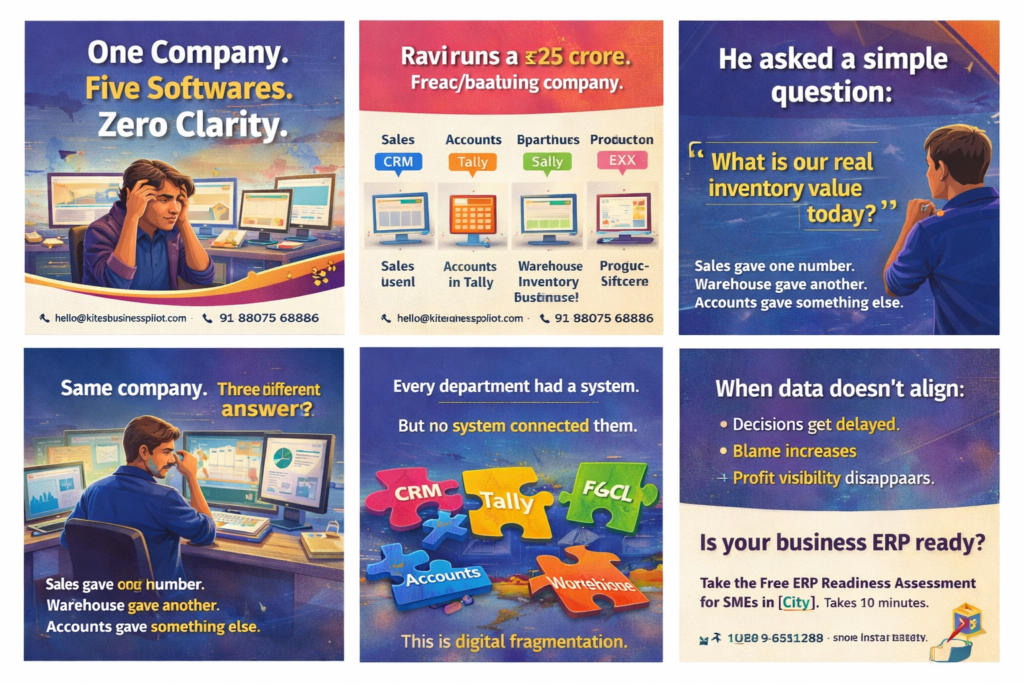
“What is our current inventory value?”
Sales shared one number.
The warehouse shared another.
Accounts had a different figure.
Everyone worked hard. Yet the numbers didn’t match.
The problem was not effort. The problem was disconnected software.
Sales used one system.
Accounts used another.
Inventory ran on separate software.
Production depended on Excel sheets.
Because these systems did not connect, data stayed scattered.
As a result, Ravi had no clear view of his business.
Day 2 – Conflict: The Blame Game Begins
Soon, customer orders were delayed.
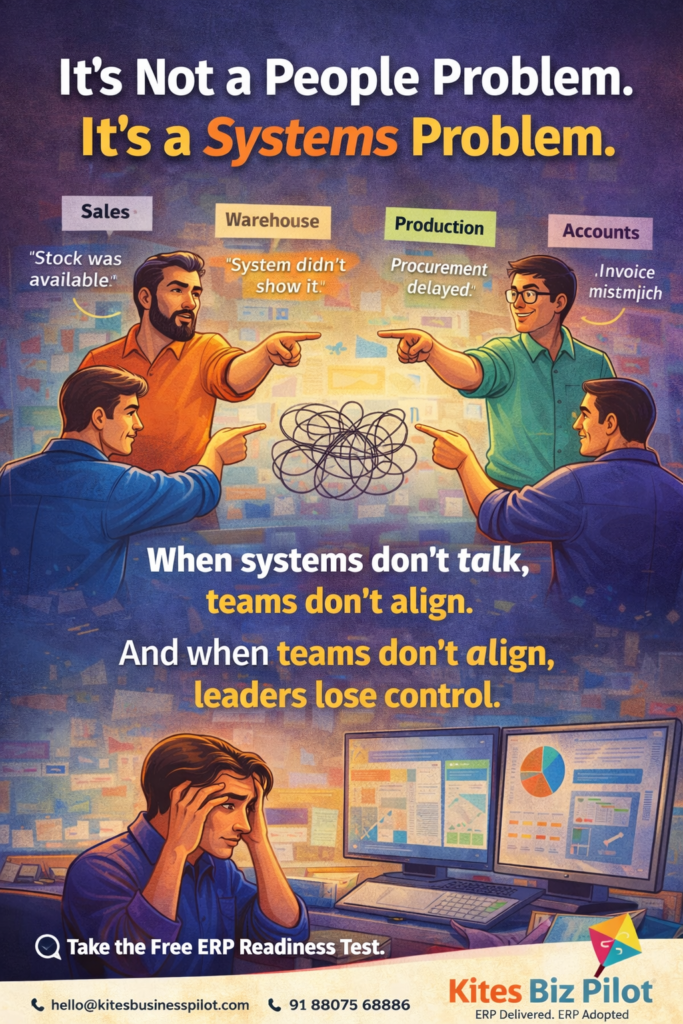
Sales said stock was available.
The warehouse said it was not updated.
Production blamed procurement.
Accounts blamed data mismatch.
Tension increased.
However, the issue was not poor teamwork. It was poor integration.
When systems do not talk to each other, teams cannot align. Therefore, confusion turns into conflict.
Over time, trust drops. Meetings become defensive. Leaders feel stuck.
Day 3 – Control Loss: Reports Take Too Long
Monthly review meetings became stressful.
It took four days to finalize one report.
First, sales data was collected.
Next, inventory numbers were corrected.
Then, finance adjusted entries.
Finally, a revised report was prepared.
By that time, the numbers were already old.
Delayed data leads to delayed decisions.
If your reports need multiple Excel files and repeated corrections, you do not have real-time control. Instead, you have manual patchwork.
This is common in growing SMEs without integrated ERP systems.
Day 4 – Scaling Risk: Expansion Creates Chaos
Ravi opened a second warehouse.
He expected growth. Instead, he faced new problems.
Inventory did not sync.
Stock transfers were unclear.
Accounts could not match stock movement.
Sales oversold products.
The business grew. However, the systems did not.
When companies expand without integrated software, complexity increases fast. Therefore, small gaps become big risks.
Scaling with disconnected tools is risky. It weakens the foundation of growth.
Day 5 – Clarity: Systems Finally Unite
After months of stress, Ravi made a decision.
He moved to an integrated ERP system.
Sales, inventory, production, and finance now worked inside one platform.
The impact was clear.
There was one dashboard.
Data updated in real time.
Reports were instant.
Departments aligned naturally.
Meetings became shorter. Decisions became faster. Confidence returned.
ERP did not just change software. It changed visibility.
Why This Story Matters for SME Owners
Many growing businesses face the same pattern:
First comes confusion.
Then comes conflict.
After that comes loss of control.
Next comes scaling risk.
Finally, clarity comes only after integration.
Growth is not the problem.
Disconnected systems are.
How ERP Helps Manufacturing & Distribution SMEs
ERP for manufacturing and distribution SMEs brings everything into one system.
It helps you:
- Track inventory in real time
- Connect sales with stock
- Automate accounting entries
- Generate instant reports
- Manage multiple warehouses
- Improve decision-making
Because all departments use the same data, alignment improves automatically.
Are You Ready for ERP?
Before implementation, readiness matters.
An ERP readiness assessment helps you understand:
- Where data gaps exist
- Which processes need standardization
- Whether your team is prepared
- How scalable your current systems are
This step reduces risk and improves ERP success.
Final Thought
If your business feels busy but unclear, pause and evaluate.
If reporting feels slow, examine your systems.
If departments blame each other, look at integration.
ERP is not about complexity. It is about clarity.
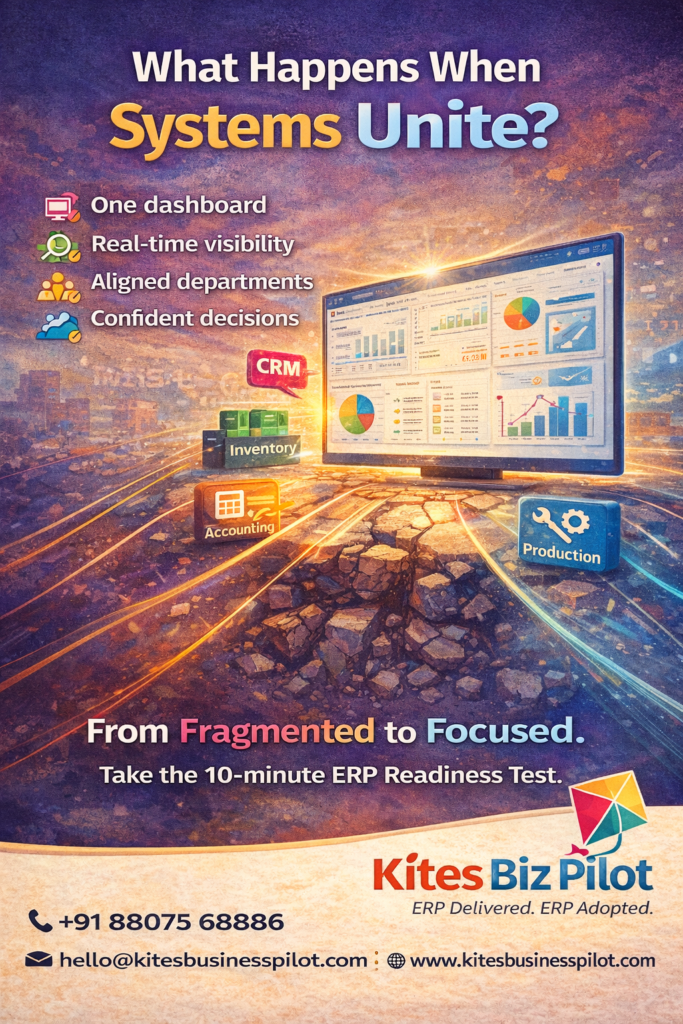
When systems unite, leaders regain control.