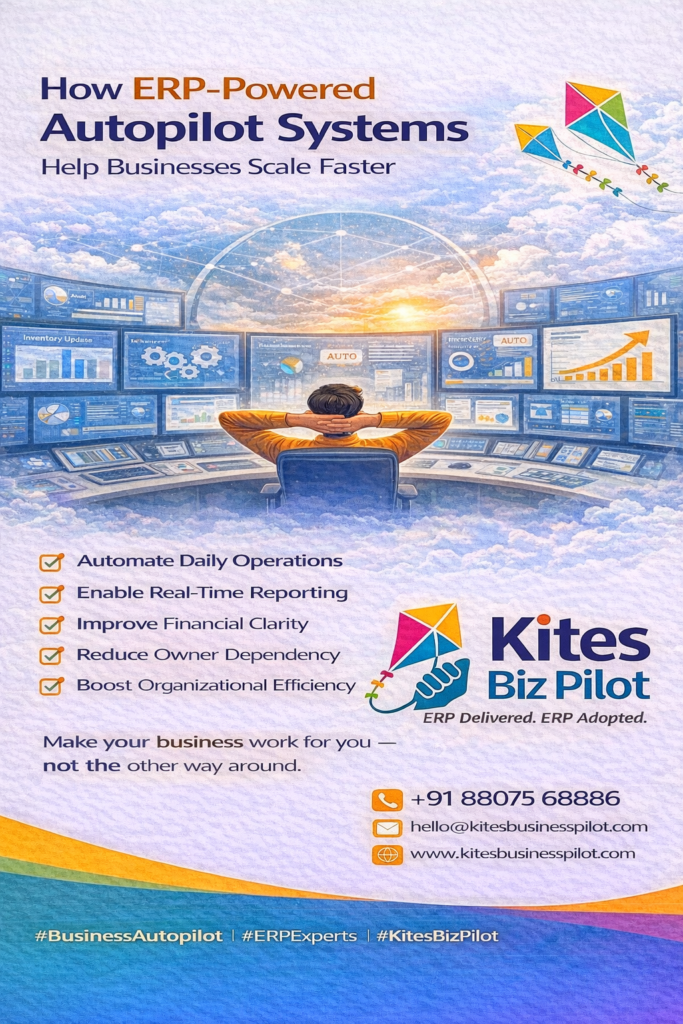
Many small and medium businesses reach a stage where Excel sheets, disconnected software, and manual processes slow down growth.
Sales increase.
Operations become complex.
Inventory mismatches start appearing.
Financial reports take days instead of minutes.
At this point, business owners start searching for ERP for SME.
But the biggest concern quickly appears:
“ERP is too expensive for a small or medium business.”
This fear often comes from the traditional commercial ERP model, which can become a costly trap for many SMEs.
Today, open-source ERP platforms are offering a much smarter and affordable path to digital transformation.
Why SMEs Need ERP Systems
An ERP system connects all departments in one integrated platform.
Instead of separate software for accounting, inventory, sales, and purchase, ERP provides one unified business system.
A well-implemented ERP for SMEs can help with:
• Real-time financial visibility
• Accurate inventory management
• Faster order processing
• Better purchase planning
• Clear business reports
• Improved decision making
In short, ERP helps business owners run the company with clarity instead of assumptions.
The Commercial ERP Trap for SMEs
Many SME owners initially explore well-known commercial ERP solutions.
However, they soon discover a common pattern.
1. High License Costs
Most commercial ERP vendors charge per user license fees.
As your team grows, the software cost increases every year.
A typical SME with 20–30 users may end up paying lakhs of rupees annually just for licenses.
2. Expensive Implementation
Commercial ERP projects often involve:
• Large consulting teams
• Long implementation timelines
• Heavy customization costs
The implementation cost alone can reach ₹20 lakh to ₹1 crore, depending on the system.
For many SMEs, this becomes a major financial risk.
3. Vendor Lock-In
Once a commercial ERP is installed, businesses often become dependent on the vendor.
Every change requires:
• Paid support
• Additional licenses
• Expensive upgrades
Over time, the business loses flexibility.
4. Costly Upgrades
Many ERP vendors release new versions every few years.
But upgrading the system can involve:
• Migration costs
• Re-implementation
• Training expenses
This creates a continuous cycle of investment.
The Open Source ERP Advantage for SMEs
Open-source ERP systems provide a very different model.
Instead of paying large software licensing fees, businesses invest mainly in:
• Implementation
• Customization
• Business process improvement
Popular open-source ERP platforms include solutions like ERPNext and Odoo, which are widely used by SMEs around the world.
Key Benefits of Open Source ERP for SMEs
1. Lower Cost of Ownership
Open-source ERP typically eliminates large software license fees.
Businesses pay primarily for:
• Implementation
• Hosting
• Support
This makes ERP adoption much more affordable for growing companies.
2. Flexibility and Customization
Every SME operates differently.
Open-source ERP allows businesses to adapt the system to their workflow instead of forcing operations to match rigid software rules.
This flexibility is critical for:
• Manufacturing businesses
• Trading companies
• Project-based organizations
3. No Vendor Lock-In
With open-source ERP, businesses retain full control over their data and system.
They are not dependent on a single vendor.
This ensures long-term flexibility.
4. Scalable Growth
Open-source ERP systems can grow with the business.
New modules can be added as operations expand:
• CRM
• Manufacturing
• Projects
• HR
• Analytics
This makes ERP a long-term business platform rather than a one-time software purchase.
The Real ERP Success Factor for SMEs
ERP success is not only about choosing software.
Many ERP projects fail because businesses focus on technology instead of processes.
For ERP to deliver results, companies must focus on:
• Clear business processes
• Data discipline
• Department coordination
• Leadership involvement
ERP should be seen as a business transformation initiative, not just a software installation.
ERP ROI for Small and Medium Businesses
When implemented properly, ERP can significantly improve business performance.
SMEs typically see improvements in:
✔ Inventory control
✔ Cash flow management
✔ Faster financial reporting
✔ Reduced operational leakages
✔ Better strategic decisions
Many SMEs recover their ERP investment within 12–24 months through operational efficiency and cost savings.
The Future of ERP for SMEs
Digital transformation is no longer optional.
SMEs that continue operating with disconnected systems face growing challenges:
• Poor visibility
• Data errors
• Slow decision making
• Hidden profit losses
Open-source ERP provides a practical and cost-effective way for SMEs to modernize operations without falling into the commercial ERP cost trap.
Businesses that adopt integrated systems today will build stronger, more scalable organizations for the future.
Final Thought
ERP is not about software.
It is about running your business with clarity, control, and confidence.
For SMEs looking to grow sustainably, open-source ERP can provide the right balance between technology, flexibility, and affordability.
📞 +91 88075 68886
📧 hello@kitesbusinesspilot.com
🌐 www.kitesbusinesspilot.com