
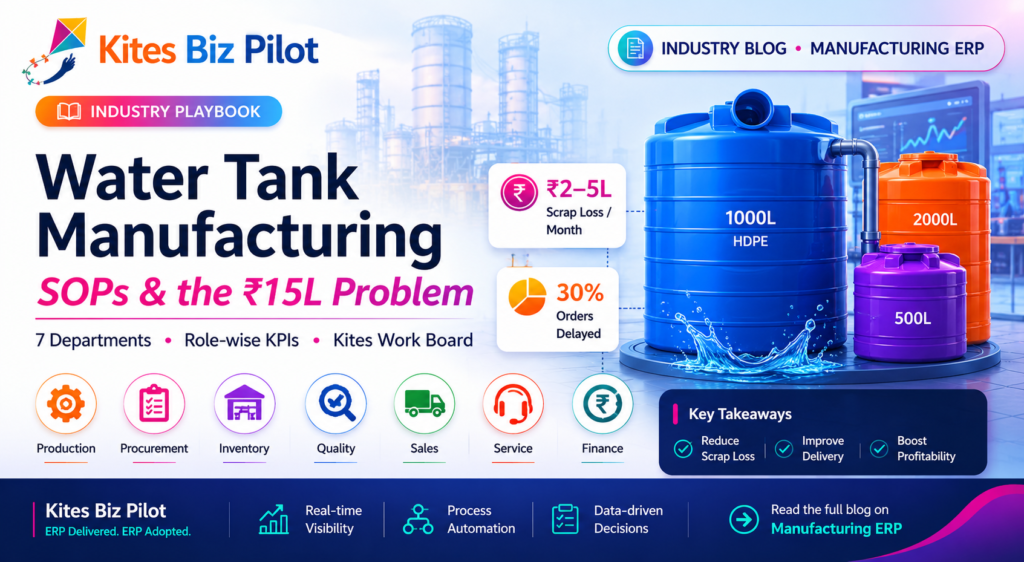
How a rotational moulded plastic tank factory loses lakhs every month without structured SOPs — and how Kites Work Board turns every department into a performance engine.
IndustryPlastic / HDPE / Rotomoulding
Coverage7 Departments · 20+ Roles
SolutionKites Work Board + ERPNext
ByKites Biz Pilot
₹2–5L
Scrap loss / month (untracked)
15–20%
Material variance (no BOM control)
30%
Orders delayed (no dispatch SOP)
0
Visibility on shift performance
₹25Cr
Possible with full operational control
Why This Industry Needs SOPs More Than Most
Water tank manufacturing is a high-volume, cost-sensitive business. Every kilogram of LLDPE granule wasted, every delayed truck, every unrecorded leakage complaint — it eats directly into your margin. The owner knows this. But without department-wise SOPs enforced by a performance system, this knowledge stays in the owner’s head and never reaches the shop floor.
Owner’s reality: “I know the problems. My production head knows. My store person knows. But nobody tracks it, nobody reports it, and every month the same problems repeat.”
Department-Wise SOPs & Role Clarity
Seven departments. Every role mapped. Every SOP defined. Every KPI powered by Kites Work Board.
🏭
01. Procurement & Stores Department
Raw Material Inward · Vendor Management · Stock Control
Purchase Manager
Vendor negotiations, PO approval
Purchase Executive
Quotation comparison, order placement
Store Keeper
GRN, batch entry, bin management
Quality Inward
Granule sampling, certificate check
Standard Operating Procedure
Reorder Trigger: When LLDPE granule stock drops below 7-day buffer (plant MRP auto-raises material request in ERPNext)
Supplier Quotation: Minimum 2 quotes compared for every purchase above ₹50,000. Rate vs last purchase recorded.
Purchase Order: PO raised with approved rate, GST rate (18% IGST for inter-state, 9+9 CGST/SGST for local), delivery date, batch number instruction.
GRN (Good Receipt Note): Store keeper verifies qty, weight, batch label, and supplier invoice match before unloading. No entry = no payment.
Quality Inward Check: Visual granule check, moisture content test (card test), COA (Certificate of Analysis) filed against batch number.
Bin Allocation: Each batch assigned to a specific bin location in Raw Material Warehouse. FIFO strictly followed — older batch issued first.
Purchase Invoice Entry: Within 24 hours of GRN. GST input credit claimed correctly. Three-way match: PO + GRN + Invoice.
Pain Points (Without System)
- Granule prices vary 8–12% month to month — no comparison done
- Batch mixing leads to quality complaints with no root cause
- Over-purchasing tied up ₹8–12L as dead stock
- GST input credit missed due to late invoice entries
Kites Work Board Fix
- KPI: Purchase Price Variance % tracked monthly per vendor
- KPI: GRN-to-Invoice TAT ≤ 24 hrs — scored in Work Board
- KPI: Stock Days of Raw Material maintained at 7–10 days
- KPI: Quality rejection % at inward — batch-level alert
Work Board KPI Rules Active
Purchase Price Variance %GRN TAT (hrs)Stock Days CoverageInward Rejection RatePO Fill Rate %
⚙️
02. Production / Manufacturing Department
Roto Moulding · Work Orders · Machine Efficiency
Production Manager
Production plan, machine scheduling
Shift Supervisor
Work order execution, shift log
Machine Operator
Loading, rotation cycle, de-moulding
Helper / Loader
Material loading, mould cleaning
Finishing Operator
Trimming, fittings, sticker labelling
Standard Operating Procedure — Rotational Moulding Cycle
Shift Start Checklist: Machine condition check, oil level, mould cleanliness, availability of granules at WIP station confirmed before first cycle.
Work Order Receipt: Shift supervisor opens Work Order in ERPNext — item variant, qty, BOM confirmed. Material issue authorised from Raw Material → WIP warehouse.
Material Weighing: Granules weighed as per BOM (1000L tank = 28 kg LLDPE + 0.3 kg UV + 0.5 kg masterbatch). Any deviation recorded in job card.
Mould Loading: Correct mould for the variant fitted and locked. Mould release spray applied uniformly.
Heating & Rotation: Bi-axial rotation at set temperature profile (180–230°C depending on tank size). Cycle time recorded per machine per mould.
Cooling: Air or water cooling as per process sheet. Premature de-moulding = wall deformation. Cooling time SOP strictly followed.
De-moulding: Tank removed, mould inspected for damage. Tank handed to QC station. Mould cleaned for next cycle.
Finishing: Inlet/outlet fittings fixed, trimming done, lid fitted, sticker label applied with variant & batch info. Packed and moved to FG warehouse.
Shift Close Report: Supervisor logs: tanks produced, scrap qty, downtime reason, power reading. All entered in ERPNext work order completion.
Pain Points (Without System)
- Machine runs 20 cycles per day on paper — actually 14. No data.
- Granule issued for 50 tanks, 45 tanks made — 5 kg variance untracked
- Downtime not recorded — “machine was fine” every time
- Shift changeover — verbal handover, nothing documented
Kites Work Board Fix
- KPI: Actual cycles vs planned cycles per machine per shift
- KPI: Material consumption variance % vs BOM standard
- KPI: Machine OEE % (Availability × Performance × Quality)
- KPI: Shift production target achievement %
Work Board KPI Rules Active
Machine OEE %Cycle Time (mins)Production Achievement %Material Variance %Shift Downtime (hrs)Tanks per Machine per Day
🔬
03. Quality Control Department
In-Process Inspection · Final QC · Customer Complaint Closure
QC Manager
Quality standards, rejection root cause
QC Inspector
Thickness check, leakage test, weight
Lab Technician
UV resistance, sample testing
Standard Operating Procedure — Quality Inspection
Inward Raw Material QC: Each granule batch sampled (1 kg per 500 kg lot). Melt flow index and visual clarity checked. COA matched with supplier document.
In-Process Check (During Moulding): Temperature uniformity verified every 2 hours. Wall thickness probe test on every 5th tank off the machine.
Final Inspection — Weight Check: Each tank weighed against BOM standard. Tolerance: ±2%. Below tolerance → scrap/rework. Above tolerance → check masterbatch ratio.
Leakage Test: 100% of tanks water-filled and held for 30 minutes. Any seepage → rejected. Rejection tagged with batch, machine, operator, and shift.
UV Resistance (Sample Basis): 1 tank per batch lot kept for 72-hour UV chamber exposure. Discolouration / cracking → batch hold, granule supplier notified.
Acceptance / Rejection Decision: Accepted → moved to FG warehouse. Minor defect → rework queue. Major defect → scrap warehouse. All recorded in ERPNext Quality Inspection record.
Customer Complaint Handling: Complaint logged with delivery note reference. Batch traced back. Root cause identified within 48 hours. Corrective action documented.
Pain Points (Without System)
- No rejection data — owner finds out when distributor returns tanks
- Same defect repeats every month — no root cause loop
- Customer complaints handled verbally — no tracking
- No link between granule batch and field failure
Kites Work Board Fix
- KPI: First Pass Yield % (FPY) per machine per week
- KPI: Field complaint rate per 1000 tanks despatched
- KPI: Rejection % (in-process vs final inspection)
- KPI: Complaint closure TAT ≤ 48 hrs — scored weekly
Work Board KPI Rules Active
First Pass Yield %Rejection Rate %Complaint Closure TATRework % per ShiftScrap % vs Total Output
📦
04. Inventory & Warehouse Department
RM Store · WIP · FG Warehouse · Scrap Yard
Warehouse Manager
Stock accuracy, cycle counts, layout
FG Store Keeper
Finished goods receipts, FIFO dispatch
RM Store Keeper
Batch-wise issue against work order
Scrap Handler
Scrap weighment, segregation, regrind
Standard Operating Procedure — Stock Flow
RM Issuance: Material issued from RM warehouse only against an open work order. No work order = no issue. Batch FIFO followed. Weight reconciled against BOM qty.
WIP Tracking: Material in WIP warehouse = granules at machine floor. Any excess at end of shift returned to RM warehouse with stock transfer entry.
FG Receipts: Finished tanks received with QC Accepted tag. Counted by variant, stacked by capacity and colour. Location bin updated in ERPNext.
Physical Stock Count (Weekly): Every Saturday, FG count done by store keeper. Any variance with system reconciled, supervisor sign-off mandatory.
Scrap Handling: All moulding waste, trimming, and rejected tanks weighed and moved to Scrap Warehouse. Entry in ERPNext with work order reference.
Regrind Process: Approved scrap shredded and re-classified as “Regrind Raw Material” — maximum 10% regrind allowed in BOM. Entry created as a new batch.
Pain Points (Without System)
- FG stock mismatch every month — physical vs book never tallies
- Scrap yard full but no value assigned — hidden loss of ₹1–3L
- Wrong variant dispatched — customer returns add cost
- No FIFO — older stock sitting while fresh stock dispatched
Kites Work Board Fix
- KPI: Stock accuracy % (physical count vs system)
- KPI: Scrap value ₹ per month — visible to management
- KPI: Wrong dispatch incidents per month = zero target
- KPI: FG inventory days — optimal 12–15 days
Work Board KPI Rules Active
Stock Accuracy %FG Inventory DaysScrap Value ₹/MonthRegrind Utilisation %Dispatch Error Rate
📈
05. Sales & Distribution Department
Dealer Network · Project Sales · Credit Control · Collections
Sales Manager
Channel strategy, target setting, pricing
Area Sales Executive
Dealer visits, order collection, follow-up
Inside Sales / CRM
Quotation, order entry, payment follow-up
Collection Executive
Outstanding follow-up, PDC management
Standard Operating Procedure — Order to Cash
Dealer Enquiry / Order Receipt: All orders entered in ERPNext as Sales Order within 2 hours of receipt. No verbal orders accepted. WhatsApp confirmation printed and attached.
Credit Check: System checks outstanding balance vs credit limit before confirming order. Overdue customers → sales manager approval required before dispatch.
Quotation to Builders/Govt: Quotation template with MRP, dealer discount, GST breakup, delivery lead time sent within 24 hours of enquiry.
FG Availability Check: Sales order triggers FG availability check. If stock insufficient → production notified with tentative delivery date communicated to customer.
Delivery Scheduling: Once stock confirmed, Delivery Note raised. Truck/tempo allocated. Customer informed of dispatch date via WhatsApp/call same day.
Invoice & E-Way Bill: Sales Invoice raised with correct GST (18% HSN 3925 / 3926). E-Way Bill generated for consignments above ₹50,000.
Payment Follow-up: Every Monday, collection executive reviews all outstanding above 15 days. Weekly call log maintained. PDC/UPI confirmation recorded.
Pain Points (Without System)
- Dealers place verbal orders — 2 trucks reach dealer with wrong qty
- Outstanding receivables cross ₹30L with no follow-up system
- Sales executive visits dealer weekly but no call report submitted
- Seasonal demand spike — no advance production signal given
Kites Work Board Fix
- KPI: Sales target achievement % (executive-wise, week-wise)
- KPI: Overdue receivables > 30 days as % of total outstanding
- KPI: Dealer visit frequency vs plan (field team accountability)
- KPI: Order-to-dispatch TAT in days — target ≤ 3 days
Work Board KPI Rules Active
Sales Target Achievement %Overdue Receivables %Order-to-Dispatch TATDealer Visit CountNew Dealer Addition / MonthCollection Efficiency %
🚚
06. Logistics & Dispatch Department
Transport Planning · Loading · Delivery Proof · Freight Cost
Logistics Coordinator
Truck booking, route planning
Loading Supervisor
Loading accuracy, tying, count verification
Driver / Transport
Delivery execution, POD collection
Standard Operating Procedure — Dispatch
Dispatch Planning (Daily 9 AM): Logistics coordinator reviews all pending delivery notes. Prioritised by customer commitment date. Truck capacity matched to order quantities.
Loading Checklist: Loading supervisor cross-checks variant, qty, and condition against delivery note. Items loaded, counted, and signed off before truck departure.
Vehicle Number Entry: Truck number entered in ERPNext Delivery Note. E-Way Bill updated with vehicle number. Departure time logged.
Customer Intimation: Automated or manual WhatsApp message with delivery details, truck number, and ETA sent to customer at time of dispatch.
POD (Proof of Delivery): Driver collects customer signature on delivery challan copy. Photo of delivered stock uploaded to ERPNext / WhatsApp group.
Freight Cost Booking: Freight amount entered against sales invoice (either as expense or billed separately). Monthly freight per km per tonne tracked.
Pain Points (Without System)
- Loading errors — 1000L despatched instead of 500L. Return freight = loss
- POD not collected — customer denies receipt of 5 tanks
- Freight cost unmonitored — ₹2L/month overpaid to transporters
- No ETA communicated — customers call 10 times a day
Kites Work Board Fix
- KPI: Loading accuracy % (zero error = 100% score)
- KPI: POD collection rate % per week
- KPI: Freight cost per tank despatched (₹ benchmark set)
- KPI: On-time delivery % vs committed date
Work Board KPI Rules Active
On-Time Delivery %Loading Accuracy %POD Collection Rate %Freight Cost per Tank ₹Return/Damage Rate %
💰
07. Accounts & Finance Department
Cost Tracking · GST · Payroll · Profitability Reports
Accounts Manager
MIS, P&L, cost control oversight
Accounts Executive
Daily vouchers, bank reconciliation
GST Executive
GSTR-1, GSTR-3B, e-invoicing
Payroll Executive
Attendance, salary, PF/ESI compliance
Standard Operating Procedure — Accounts Flow
Daily Voucher Entry: All bank payments, cash expenses, and journal entries completed by 5 PM daily. No backlog entries older than 48 hours.
Manufacturing Cost Review (Weekly): Power bill, fuel cost, and labour cost compared against production output (cost per tank produced). Any spike investigated.
GST Filing: GSTR-1 filed by 11th of every month. GSTR-3B by 20th. ITC matched against purchase register. Any discrepancy corrected before filing.
Cost Per Unit Calculation: Monthly cost per tank for each variant = (RM cost + Power + Labour + OH) ÷ units produced. Compared vs selling price for margin analysis.
Receivables Review: Outstanding aging report reviewed every Monday. Accounts team shares collection dashboard with sales team.
Monthly P&L: Management P&L shared by 7th of following month. Variant-wise gross margin, scrap loss ₹, power cost ₹/tank highlighted.
Pain Points (Without System)
- Cost per tank is a guess — no structured cost sheet maintained
- Power bill spikes — no production linkage to identify OT consumption
- P&L available only in March after CA finalises books
- GST mismatches because purchase entries delayed
Kites Work Board Fix
- KPI: Cost per tank ₹ (variant-wise) — tracked weekly
- KPI: Power cost ₹ per 1000 tanks produced
- KPI: Gross margin % (product-wise) — Management scorecard
- KPI: GST compliance score — filing dates vs deadline
Work Board KPI Rules Active
Cost per Tank ₹Gross Margin % (Variant-wise)Power Cost / 1000 TanksReceivables Overdue %GST Filing ComplianceMonthly P&L TAT (days)
HR & Payroll Note: Factory staff — machine operators, helpers, supervisors, and sales team — are managed through ERPNext Attendance and Shift modules. Labour cost flows directly into manufacturing cost per work order, giving accurate per-tank costing. Kites Work Board tracks attendance adherence %, overtime hours per shift, and absenteeism rate as management KPIs.
Kites Work Board · Performance Intelligence Layer
From SOP on Paper to
Scores on Screen
Kites Work Board sits on top of ERPNext and turns every SOP into a measurable KPI. Every role gets a scorecard. Every week, the owner sees exactly where the factory is winning and where money is leaking.
Production
Machine OEE %
Availability × Performance × Quality
74%
Target: 85% → Gap = ₹3.2L/month opportunity
Quality
First Pass Yield
Good Units ÷ Total Produced × 100
91.2%
Target: 97% → 5.8% gap = ₹1.8L scrap/month
Sales
Collection Efficiency
Collected ÷ Due (30-day) × 100
68%
Target: 90% → ₹12L stuck in receivables
Procurement
Purchase Price Variance
Actual Rate vs Standard Rate %
−4.2%
Buying ₹4.20 more per kg → ₹2.1L overspend/month
Logistics
On-Time Delivery
Delivered on Date ÷ Total Dispatched × 100
72%
Target: 95% → 28% delayed = dealer dissatisfaction
Finance
Cost per Tank (1000L)
Total Mfg Cost ÷ Units Produced
₹1,840
Standard: ₹1,680 → ₹160 excess = margin erosion
Department Summary: Problem → SOP → KPI
The complete one-page view your management meeting needs every Monday morning.
| Department | Biggest Problem | Key SOP | Work Board KPI | Monthly ₹ Impact |
|---|---|---|---|---|
| Procurement | Granule price overpayment | 2-quote comparison, 3-way match | Purchase Price Variance % | ₹1–2L saved |
| Production | Unrecorded downtime & yield loss | Shift log, BOM-based issue, job card | Machine OEE %, Cycle Count | ₹2–4L recovered |
| Quality | Repeat defects, field returns | 100% leakage test, batch traceability | First Pass Yield %, FPY | ₹1–3L scrap reduced |
| Inventory | FG mismatch, scrap untracked | Weekly count, FIFO, scrap entry | Stock Accuracy %, Scrap ₹ | ₹1–2L visibility |
| Sales | Overdue receivables | Credit check before dispatch, weekly follow-up | Collection Efficiency %, OTD | ₹5–10L cash freed |
| Logistics | Loading errors, delayed delivery | Loading checklist, POD mandatory | On-Time Delivery %, Freight/Tank | ₹50K–1L freight saved |
| Finance | No real-time P&L or cost/tank | Weekly cost review, daily vouchers | Cost per Tank ₹, Gross Margin % | Decision intelligence |
Total recoverable value: A mid-size water tank manufacturer doing ₹3–5 Cr/year typically has ₹8–15 lakhs per month in operational leakage — across procurement overpayment, scrap loss, receivable delays, and freight overspend. Odoo + Kites Work Board gives you the system to see it, measure it, and eliminate it — department by department.
Ready to Put Your Factory on Autopilot?
We’ve done this for manufacturers across Tamil Nadu. From Erode to Madurai, Indian SME factory owners are now running their operations with real numbers — not guesswork.📞 Talk to Us — Free Discovery Call💬 WhatsApp Us
hello@kitesbusinesspilot.com · www.kitesbusinesspilot.com · +91 88075 68886