Kites Biz Pilot Introduction
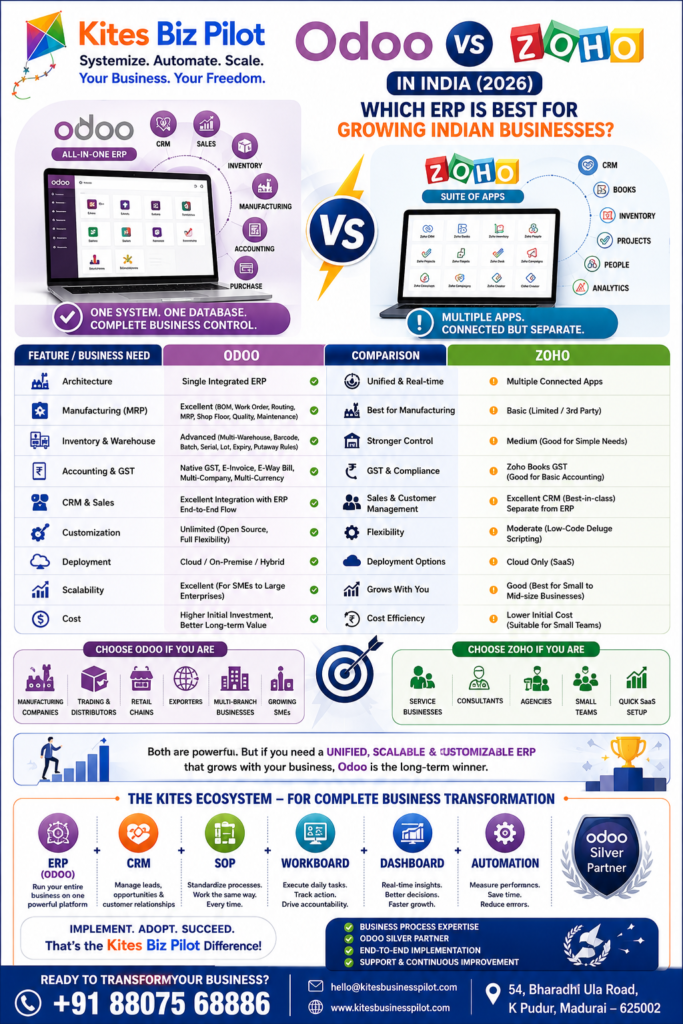
Choosing the right ERP software is one of the biggest decisions for any growing business. In India, two names often come up: Odoo and Zoho. Both are excellent business platforms, but they are designed for different types of businesses. This guide compares Odoo and Zoho based on real business requirements such as CRM, Sales, Inventory, Manufacturing, Accounting, GST, Customization, Pricing, and Scalability.
1. Architecture
Odoo is built on a single database. Every department shares the same data:
- CRM
- Sales
- Inventory
- Purchase
- Manufacturing
- Accounting
Everything updates in real time.
Zoho is a collection of multiple applications. Examples:
- Zoho CRM
- Zoho Books
- Zoho Inventory
- Zoho Projects
These applications integrate well but remain separate products.
Winner: Odoo
2. Manufacturing
Odoo includes:
- BOM
- Work Orders
- Production Planning
- Routing
- Shop Floor
- MRP
- Quality
- Maintenance
Zoho is primarily designed for service, sales, and trading businesses. Manufacturing usually requires third-party applications.
Winner: Odoo
3. Inventory
Odoo supports:
- Multi Warehouse
- Barcode
- Batch
- Serial Number
- Lot Tracking
- Expiry
- Putaway Rules
- Reordering Rules
Zoho Inventory is suitable for standard inventory needs but has limitations for complex warehouse operations.
Winner: Odoo
4. CRM & Sales
Both platforms provide:
- Lead Management
- Quotations
- Follow-ups
- Sales Pipeline
- Email Integration
- Customer History
Zoho CRM is highly mature and easy to use. Odoo CRM integrates seamlessly with ERP modules, making it a stronger choice for businesses needing end-to-end process integration.
Winner: Tie (depends on business needs)
5. Accounting & GST
Both support Indian GST. Odoo offers:
- GST
- E-Invoice
- E-Way Bill Integration
- Multi-company
- Multi-currency
- Financial Reporting
Zoho Books also provides robust GST capabilities but is focused mainly on accounting.
Winner: Tie
6. Customization
Odoo is open-source. Businesses can:
- Create custom modules
- Modify workflows
- Add fields
- Build dashboards
- Automate approvals
Zoho provides low-code customization with Deluge scripting but is less flexible for deep ERP modifications.
Winner: Odoo
7. Pricing
Zoho generally has a lower initial cost for small businesses. Odoo may involve higher implementation costs but often delivers greater long-term value for businesses with complex operations.
Winner: Depends on business size and requirements
Which Businesses Should Choose Zoho?
- Small service businesses
- Consultants
- Marketing agencies
- Companies focused mainly on CRM
- Businesses looking for a quick SaaS setup
Which Businesses Should Choose Odoo?
- Manufacturing
- Trading
- Distribution
- Retail Chains
- Exporters
- Multi-branch companies
- Businesses planning to scale
- Companies seeking a unified ERP platform
Final Verdict
If your business mainly requires CRM, invoicing, and basic operations, Zoho is a strong and cost-effective choice. If you need a comprehensive ERP that integrates manufacturing, inventory, sales, accounting, CRM, purchasing, and business intelligence into a single platform, Odoo stands out as the better long-term solution.
About Kites Biz Pilot
Selecting the right ERP is only the first step. Successful implementation, user adoption, and process standardization are what determine long-term business success. Kites Biz Pilot specializes in helping Indian SMEs implement Odoo ERP effectively by combining:
- ERP Implementation
- SOP Design
- CRM
- WorkBoard
- Dashboards
- Automation
- Business Consulting