Kites Biz Pilot Introduction
Choosing the right ERP software is one of the biggest decisions for any growing business. In India, two names often come up: Odoo and Zoho. Both are excellent business platforms, but they are designed for different types of businesses. This guide compares Odoo and Zoho based on real business requirements such as CRM, Sales, Inventory, Manufacturing, Accounting, GST, Customization, Pricing, and Scalability.
1. Architecture
Odoo is built on a single database. Every department shares the same data:
- CRM
- Sales
- Inventory
- Purchase
- Manufacturing
- Accounting
Everything updates in real time.
Zoho is a collection of multiple applications. Examples:
- Zoho CRM
- Zoho Books
- Zoho Inventory
- Zoho Projects
These applications integrate well but remain separate products.
Winner: Odoo
2. Manufacturing
Odoo includes:
- BOM
- Work Orders
- Production Planning
- Routing
- Shop Floor
- MRP
- Quality
- Maintenance
Zoho is primarily designed for service, sales, and trading businesses. Manufacturing usually requires third-party applications.
Winner: Odoo
3. Inventory
Odoo supports:
- Multi Warehouse
- Barcode
- Batch
- Serial Number
- Lot Tracking
- Expiry
- Putaway Rules
- Reordering Rules
Zoho Inventory is suitable for standard inventory needs but has limitations for complex warehouse operations.
Winner: Odoo
4. CRM & Sales
Both platforms provide:
- Lead Management
- Quotations
- Follow-ups
- Sales Pipeline
- Email Integration
- Customer History
Zoho CRM is highly mature and easy to use. Odoo CRM integrates seamlessly with ERP modules, making it a stronger choice for businesses needing end-to-end process integration.
Winner: Tie (depends on business needs)
5. Accounting & GST
Both support Indian GST. Odoo offers:
- GST
- E-Invoice
- E-Way Bill Integration
- Multi-company
- Multi-currency
- Financial Reporting
Zoho Books also provides robust GST capabilities but is focused mainly on accounting.
Winner: Tie
6. Customization
Odoo is open-source. Businesses can:
- Create custom modules
- Modify workflows
- Add fields
- Build dashboards
- Automate approvals
Zoho provides low-code customization with Deluge scripting but is less flexible for deep ERP modifications.
Winner: Odoo
7. Pricing
Zoho generally has a lower initial cost for small businesses. Odoo may involve higher implementation costs but often delivers greater long-term value for businesses with complex operations.
Winner: Depends on business size and requirements
Which Businesses Should Choose Zoho?
- Small service businesses
- Consultants
- Marketing agencies
- Companies focused mainly on CRM
- Businesses looking for a quick SaaS setup
Which Businesses Should Choose Odoo?
- Manufacturing
- Trading
- Distribution
- Retail Chains
- Exporters
- Multi-branch companies
- Businesses planning to scale
- Companies seeking a unified ERP platform
Final Verdict
If your business mainly requires CRM, invoicing, and basic operations, Zoho is a strong and cost-effective choice. If you need a comprehensive ERP that integrates manufacturing, inventory, sales, accounting, CRM, purchasing, and business intelligence into a single platform, Odoo stands out as the better long-term solution.
About Kites Biz Pilot
Selecting the right ERP is only the first step. Successful implementation, user adoption, and process standardization are what determine long-term business success. Kites Biz Pilot specializes in helping Indian SMEs implement Odoo ERP effectively by combining:
- ERP Implementation
- SOP Design
- CRM
- WorkBoard
- Dashboards
- Automation
- Business Consulting
Why Your Business Needs More Than Excel Sheets and WhatsApp
Every business owner wants more customers, more sales, and better profits.
But here’s the reality.
Many businesses don’t lose customers because of poor products. They lose customers because they don’t have a proper system.
If your business depends on memory, WhatsApp chats, Excel files, or handwritten notes, you are already losing opportunities every day.
A customer asks for a quotation.
Someone forgets to follow up.
A salesperson leaves the company.
Customer history disappears.
The result?
Lost revenue.
Missed opportunities.
Frustrated customers.
This is exactly why businesses need a modern CRM.
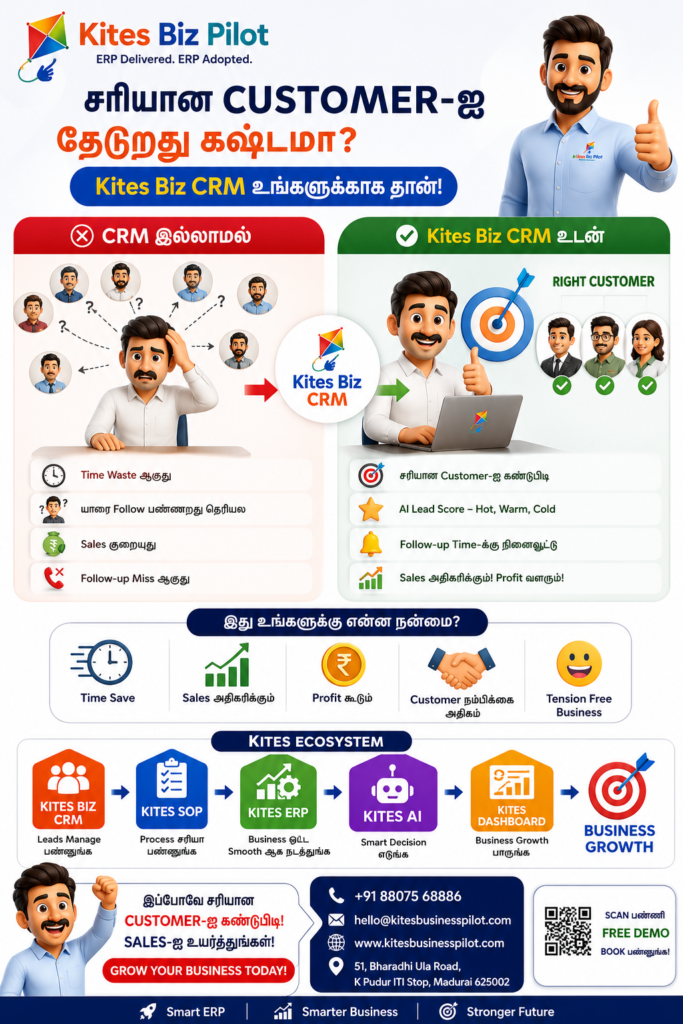
At Kites Biz Pilot, we built Kites Biz CRM to help growing businesses organize their sales process, improve customer relationships, and increase conversions without adding complexity.
What is Kites Biz CRM?
Kites Biz CRM is a customer relationship management system designed specifically for small and medium-sized businesses.
Instead of storing customer information in different places, Kites Biz CRM keeps everything in one secure platform.
You can manage:
- Leads
- Customers
- Sales opportunities
- Follow-ups
- Quotations
- Sales team activities
- Reports
- Business dashboards
Everything becomes visible.
Everything becomes measurable.
Everything becomes manageable.
Common Problems Business Owners Face
Many business owners tell us the same story.
“We receive many enquiries but don’t know which ones are genuine.”
“Our sales team forgets follow-ups.”
“We don’t know which marketing source gives the best customers.”
“We don’t know why sales are dropping.”
“Our customer information is scattered everywhere.”
Sound familiar?
These are not people problems.
They are system problems.
How Kites Biz CRM Helps Your Business Grow
1. Capture Every Lead
Whether your enquiry comes from:
- Website
- Facebook
- Instagram
- Google Ads
- WhatsApp
- Referral
- Walk-in customer
Every lead is stored automatically.
Nothing gets missed.
2. Find Your Best Customers
Not every enquiry becomes a customer.
Kites Biz CRM helps you identify your Ideal Customer Profile (ICP).
Instead of chasing everyone, your team focuses on customers who are most likely to buy.
This saves time and improves conversion rates.
3. Smart Lead Scoring
Imagine knowing which customer is ready to purchase today.
Kites Biz CRM scores leads based on factors like:
- Business size
- Industry
- Budget
- Buying interest
- Previous interactions
- Engagement level
Your sales team spends more time on high-value prospects instead of cold leads.
4. Never Miss a Follow-up Again
Most sales are lost because businesses fail to follow up consistently.
Kites Biz CRM sends reminders for:
- Calls
- Meetings
- Quotations
- Renewals
- Customer check-ins
Your team always knows the next action.
5. Know Your Sales Pipeline
Instead of guessing your monthly sales, you can see exactly where every opportunity stands.
Example stages:
New Lead → Qualified → Meeting Scheduled → Proposal Sent → Negotiation → Won
This visibility helps business owners make better decisions.
6. Measure Team Performance
As a business owner, you can instantly see:
- Number of new leads
- Calls completed
- Meetings conducted
- Quotations sent
- Deals won
- Conversion percentage
No more assumptions.
Only data-driven decisions.
Why SMEs Choose Kites Biz CRM
Unlike complicated enterprise CRM software, Kites Biz CRM is built for growing businesses.
It is:
- Easy to learn
- Affordable
- Customizable
- Mobile-friendly
- Scalable
- Integrated with business workflows
Whether you have a sales team of two people or fifty, the system grows with your business.
More Than CRM – A Complete Business Growth System
CRM is only one part of business success.
Kites Biz Pilot helps businesses build complete systems through:
- Business Process Consulting
- Standard Operating Procedures (SOP)
- ERP Implementation
- CRM Solutions
- AI Automation
- Management Dashboards
- Business Analytics
Our goal is simple:
Build businesses that run on systems, not stress.
Is Kites Biz CRM Right for Your Business?
Kites Biz CRM is ideal for:
- Manufacturers
- Distributors
- Retail businesses
- Service companies
- Educational institutions
- Healthcare providers
- Real estate businesses
- Consulting firms
- Construction companies
- Startups
- Growing SMEs
If you want predictable sales and better customer management, CRM is no longer optional.
It is essential.
Final Thoughts
Technology doesn’t grow a business.
The right system does.
Businesses that consistently follow up, track customer relationships, and make decisions using data always outperform businesses that rely on memory.
If you’re serious about scaling your business, start by organizing your sales process.
Kites Biz CRM helps you convert more leads, improve customer experience, and create a business that grows with confidence.
Ready to Build a System-Driven Business?
Kites Biz Pilot
ERP Delivered. ERP Adopted.
📍 51, Bharadhi Ula Road, K Pudur ITI Stop, Madurai – 625002
📞 +91 88075 68886
📧 hello@kitesbusinesspilot.com
🌐 www.kitesbusinesspilot.com
Book a free CRM consultation and discover how Kites Biz CRM can transform your sales process.
Every growing business reaches a point where spreadsheets, manual updates, and disconnected teams start slowing things down. What looks manageable at first quickly turns into chaos.
Let’s walk through a typical day in a company without ERP — and how switching to Odoo with Kites Biz Pilot transforms everything into an autopilot-driven system.
⏰ 9:00 AM — Sales Wins, But Finance Loses
Your sales team closes a deal. Great news, right?
But accounting hasn’t updated invoices yet. No real-time visibility. No financial clarity.
👉 With Odoo ERP:
Sales confirmations automatically trigger invoice generation. No delays. No confusion.
📦 11:30 AM — Inventory Chaos
System says “In Stock.” Reality says “Out of Stock.”
Result? Delayed orders and frustrated customers.
👉 With Odoo Inventory:
Stock updates happen in real time. What you see is what you have.
📊 2:00 PM — No Single Source of Truth
Sales reports say one number. Operations says another. Finance shows something else.
👉 With Odoo Dashboard:
One system. One version of truth. Real-time analytics across departments.
📑 4:30 PM — Finance Struggles to Reconcile
Spreadsheets, emails, and manual entries pile up. Hours wasted just understanding what already happened.
👉 With Odoo Accounting:
Everything is connected — automated entries, live tracking, and instant reports.
🔄 From Chaos to Clarity: Business on Autopilot
Without ERP:
- Disconnected teams
- Manual processes everywhere
- Errors and duplication
- Zero real-time visibility
- Missed opportunities
With Odoo + Kites Biz Pilot:
- Automated workflows from sales to finance
- Real-time inventory and reporting
- Seamless team collaboration
- Faster, data-driven decisions
- Scalable growth
✨ Why “Autopilot” Matters
Running a business shouldn’t mean constantly firefighting problems.
With the right ERP system, your operations run in the background — accurately, efficiently, and automatically.
That’s what business autopilot really means:
Less manual effort. More strategic growth.
💡 Final Thought
If your business still relies on disconnected tools, you’re not just losing time — you’re losing opportunities.
It’s time to move from confusion to clarity.
📞 Get Started with Kites Biz Pilot
📱 +91 88075 68886
📧 hello@kitesbusinesspilot.com
🌐 www.kitesbusinesspilot.com
Odoo #ERP #BusinessAutomation #DigitalTransformation #KitesBizPilot #TamilPreneur #StartupGrowth
Many businesses choose Odoo ERP for its flexibility and open-source power.
However, after implementation, most SME owners face a common problem:
👉 “Odoo is powerful… but it doesn’t fully match how my business works.”
If you are trying to force your business into standard Odoo workflows, you are not alone.
❌ The Real Problem: Standard Odoo is Not Enough
Odoo gives you modules.
But your business needs custom workflows.
Here’s what most users struggle with:
❌ Too many manual workarounds
❌ Reports not matching real business needs
❌ Difficulty in modifying workflows
❌ Dependency on freelancers with no long-term support
❌ Fear of breaking the system during customization
👉 Result: You are using only 40–50% of Odoo’s real power.
💡 Why Odoo Customization is the Key
Odoo is not just software.
It is a framework to build your business system.
When customized correctly, Odoo can:
✔ Match your exact business process
✔ Automate repetitive work
✔ Give real-time insights
✔ Reduce dependency on manual tracking
✔ Scale as your business grows
🔧 What Kind of Odoo Customization Do SMEs Need?
At Kites Biz Pilot, we commonly see these needs:
📊 Custom Reports & Dashboards
- Profit by project / site
- Cash flow tracking
- Real-time KPI dashboards
🔄 Workflow Automation
- Approval flows (Purchase, Sales, Payments)
- Task-based triggers
- Multi-level validations
🏗️ Industry-Specific Customization
- Construction & builder workflows
- Project billing & milestone tracking
- Contractor-based accounting
🔗 Integration
- Tally integration
- Third-party apps
- Custom APIs
📱 User-Friendly Interfaces
- Simplified screens for staff
- Mobile-friendly dashboards
- Role-based access
⚠️ Why Most Odoo Customizations Fail
Let’s be honest.
Customization fails not because of Odoo…
but because of poor execution.
👉 Common mistakes:
❌ Cheap developers with no business understanding
❌ Over-customization without structure
❌ No documentation
❌ No long-term support
❌ No alignment with business goals
🚀 The Kites Biz Pilot Approach
We don’t just “customize Odoo”.
👉 We build a Business Autopilot System.
🧩 Step 1: Understand Your Business Deeply
We map:
✔ Your current workflow
✔ Pain points
✔ Decision bottlenecks
🚀 The Kites Biz Pilot Approach
We don’t just “customize Odoo”.
👉 We build a Business Autopilot System.
🧩 Step 1: Understand Your Business Deeply
We map:
✔ Your current workflow
✔ Pain points
✔ Decision bottlenecks
🛠️ Step 2: Design Smart Customization
👉 Not over-complicated
👉 Not generic
Only what your business needs to:
✔ Save time
✔ Reduce errors
✔ Improve control
⚙️ Step 3: Build & Integrate
We handle:
✔ Odoo module customization
✔ Workflow automation
✔ External integrations
✔ Performance optimization
📈 Step 4: Ensure Adoption (Most Important)
Many ERP projects fail here.
We ensure:
✔ Team training
✔ Easy interfaces
✔ Real usage
👉 Because ERP success = Usage, not installation
💣 What Makes Us Different?
👉 We combine:
✔ Odoo Expertise
✔ Accounting Knowledge
✔ SME Business Understanding
👉 Plus, our ecosystem:
- Kites Tally Intelligence
- Kites Work Board
- Kites Financial Discipline
👉 This gives you end-to-end control, not just ERP.
🎯 Real Impact for SMEs
After proper customization, businesses see:
✔ 30–50% reduction in manual work
✔ Better cash flow visibility
✔ Faster decision making
✔ Less dependency on individuals
📢 Final Thought
Odoo is powerful. But only when it works for YOUR business.
Stop adjusting your business to software.
👉 Start building software around your business.
📞 Get Expert Help
If you are already using Odoo but struggling with customization:
👉 Let’s fix it.
+91 88075 68886
hello@kitesbusinesspilot.com
www.kitesbusinesspilot.com
#Odoo #OdooERP #OdooCustomization #OdooImplementation #OdooDeveloper #OdooPartner
If you are an SME owner searching for the best ERP software, you have likely come across Zoho and Odoo. While both platforms are popular, choosing the right one can directly impact your cost, control, and long-term growth.
So, let’s break this down in a simple and practical way.
🧩 What SMEs Really Need from an ERP
First, it’s important to understand what truly matters in a business system.
Most SMEs need:
Clear visibility of cash flow and profit
Better control over inventory
Smooth coordination between teams
Faster and informed decision-making
However, many businesses struggle not because of effort, but because their systems are not connected.
⚖️ Zoho vs Odoo: A Quick Overview
At a glance, both Zoho and Odoo offer ERP capabilities.
However, they are built with different approaches.
Zoho focuses on simplicity and quick adoption
Odoo focuses on flexibility and scalability
Therefore, the right choice depends on your business stage and complexity.
🔍 Zoho for SMEs: Simple but Limited
To begin with, Zoho is a cloud-based platform that is easy to use.
✔ Strengths:
Simple interface
Quick implementation
Suitable for small teams
⚠️ Limitations:
However, as your business grows:
Customization becomes restricted
Costs increase with usage
Complex workflows become difficult to manage
As a result, Zoho works best for businesses with basic operations.
🚀 Odoo for SMEs: Flexible and Scalable
On the other hand, Odoo is designed to grow with your business.
Instead of forcing you to adapt,
Odoo adapts to your processes.
⭐ Key Features of Odoo
🔗 All-in-One System
All departments are connected — sales, purchase, inventory, and accounting.
⚙️ High Customization
You can tailor workflows based on your business needs.
📊 Real-Time Visibility
You get instant insights into profit, stock, and operations.
📦 Strong Inventory Control
Stock tracking becomes accurate and efficient.
🌐 Open Ecosystem
Additionally, thousands of apps and integrations are available.
💣 The Hidden Challenge SMEs Face
Many SMEs choose software based only on price or brand.
However, the real question should be:
👉 Can this system grow with your business?
When systems are limited:
Data becomes fragmented
Teams work in silos
Errors increase
Profit leaks go unnoticed
💡 Why Odoo Community + Customization Delivers ROI
This is where Odoo stands out significantly.
💰 Lower Cost of Ownership
Since Odoo Community has no heavy license fees,
you only invest in implementation and customization.
⚙️ Better Business Fit
Moreover, the system is built around your processes, not the other way around.
📈 Faster ROI
Because of this:
Operational errors reduce
Decision-making becomes faster
Productivity improves
Growth becomes scalable
🎯 Final Verdict: Zoho or Odoo?
So, how should you decide?
👉 Choose Zoho if:
Your business is small
Processes are simple
You need quick setup
👉 Choose Odoo if:
You are scaling
You need customization
You want long-term control
You want better ROI
✈️ The Smart SME Approach
Ultimately, ERP is not just software.
Instead, it is your business control system.
When you choose the right ERP:
You gain clarity
You improve control
You enable sustainable growth
🚀 Take the Next Step
If you are still unsure, don’t worry.
👉 Get a free ERP assessment for your business
📞 +91 88075 68886
📧 hello@kitesbusinesspilot.com
🌐 www.kitesbusinesspilot.com
Many small and medium businesses reach a stage where Excel sheets, disconnected software, and manual processes slow down growth.
Sales increase.
Operations become complex.
Inventory mismatches start appearing.
Financial reports take days instead of minutes.
At this point, business owners start searching for ERP for SME.
But the biggest concern quickly appears:
“ERP is too expensive for a small or medium business.”
This fear often comes from the traditional commercial ERP model, which can become a costly trap for many SMEs.
Today, open-source ERP platforms are offering a much smarter and affordable path to digital transformation.
Why SMEs Need ERP Systems
An ERP system connects all departments in one integrated platform.
Instead of separate software for accounting, inventory, sales, and purchase, ERP provides one unified business system.
A well-implemented ERP for SMEs can help with:
• Real-time financial visibility
• Accurate inventory management
• Faster order processing
• Better purchase planning
• Clear business reports
• Improved decision making
In short, ERP helps business owners run the company with clarity instead of assumptions.
The Commercial ERP Trap for SMEs
Many SME owners initially explore well-known commercial ERP solutions.
However, they soon discover a common pattern.
1. High License Costs
Most commercial ERP vendors charge per user license fees.
As your team grows, the software cost increases every year.
A typical SME with 20–30 users may end up paying lakhs of rupees annually just for licenses.
2. Expensive Implementation
Commercial ERP projects often involve:
• Large consulting teams
• Long implementation timelines
• Heavy customization costs
The implementation cost alone can reach ₹20 lakh to ₹1 crore, depending on the system.
For many SMEs, this becomes a major financial risk.
3. Vendor Lock-In
Once a commercial ERP is installed, businesses often become dependent on the vendor.
Every change requires:
• Paid support
• Additional licenses
• Expensive upgrades
Over time, the business loses flexibility.
4. Costly Upgrades
Many ERP vendors release new versions every few years.
But upgrading the system can involve:
• Migration costs
• Re-implementation
• Training expenses
This creates a continuous cycle of investment.
The Open Source ERP Advantage for SMEs
Open-source ERP systems provide a very different model.
Instead of paying large software licensing fees, businesses invest mainly in:
• Implementation
• Customization
• Business process improvement
Popular open-source ERP platforms include solutions like ERPNext and Odoo, which are widely used by SMEs around the world.
Key Benefits of Open Source ERP for SMEs
1. Lower Cost of Ownership
Open-source ERP typically eliminates large software license fees.
Businesses pay primarily for:
• Implementation
• Hosting
• Support
This makes ERP adoption much more affordable for growing companies.
2. Flexibility and Customization
Every SME operates differently.
Open-source ERP allows businesses to adapt the system to their workflow instead of forcing operations to match rigid software rules.
This flexibility is critical for:
• Manufacturing businesses
• Trading companies
• Project-based organizations
3. No Vendor Lock-In
With open-source ERP, businesses retain full control over their data and system.
They are not dependent on a single vendor.
This ensures long-term flexibility.
4. Scalable Growth
Open-source ERP systems can grow with the business.
New modules can be added as operations expand:
• CRM
• Manufacturing
• Projects
• HR
• Analytics
This makes ERP a long-term business platform rather than a one-time software purchase.
The Real ERP Success Factor for SMEs
ERP success is not only about choosing software.
Many ERP projects fail because businesses focus on technology instead of processes.
For ERP to deliver results, companies must focus on:
• Clear business processes
• Data discipline
• Department coordination
• Leadership involvement
ERP should be seen as a business transformation initiative, not just a software installation.
ERP ROI for Small and Medium Businesses
When implemented properly, ERP can significantly improve business performance.
SMEs typically see improvements in:
✔ Inventory control
✔ Cash flow management
✔ Faster financial reporting
✔ Reduced operational leakages
✔ Better strategic decisions
Many SMEs recover their ERP investment within 12–24 months through operational efficiency and cost savings.
The Future of ERP for SMEs
Digital transformation is no longer optional.
SMEs that continue operating with disconnected systems face growing challenges:
• Poor visibility
• Data errors
• Slow decision making
• Hidden profit losses
Open-source ERP provides a practical and cost-effective way for SMEs to modernize operations without falling into the commercial ERP cost trap.
Businesses that adopt integrated systems today will build stronger, more scalable organizations for the future.
Final Thought
ERP is not about software.
It is about running your business with clarity, control, and confidence.
For SMEs looking to grow sustainably, open-source ERP can provide the right balance between technology, flexibility, and affordability.
📞 +91 88075 68886
📧 hello@kitesbusinesspilot.com
🌐 www.kitesbusinesspilot.com
In today’s competitive market, business growth is not just about increasing sales.
It’s about building systems that run operations efficiently — with minimal manual intervention.
This is where ERP-powered Autopilot Systems transform the way businesses operate.
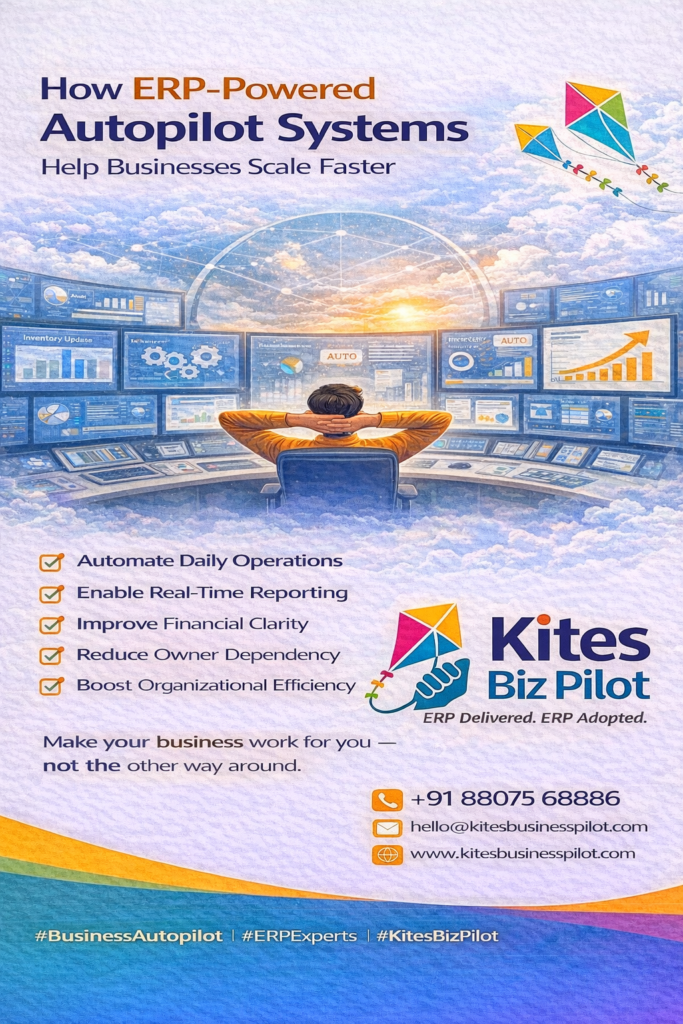
What is a Business Autopilot System?
A Business Autopilot System is a structured operational model where:
- Processes run automatically
- Reports generate in real-time
- Inventory updates instantly
- Financial data stays accurate
- Approvals follow predefined workflows
Instead of depending on individuals, the business depends on systems.
And the engine behind this automation?
An effectively implemented ERP system.
Why Traditional Businesses Struggle to Scale
Many growing businesses still rely on:
- Manual Excel tracking
- Separate software for accounts, inventory, and sales
- Delayed reporting
- Lack of real-time visibility
- Owner-dependent decision-making
This creates operational bottlenecks.
Without systemization, scaling becomes chaotic.
How ERP Creates an Autopilot Business Model
An ERP system integrates all departments into one centralized platform.
When implemented strategically, ERP enables:
1. Process Automation
Routine tasks like invoicing, stock updates, payroll, and purchase orders are automated.
2. Real-Time Visibility
Business owners get instant access to dashboards and performance reports.
3. Data Accuracy
No duplicate entries. No mismatched inventory. No financial confusion.
4. Accountability & Workflow Control
Defined approval hierarchies reduce errors and improve operational discipline.
5. Reduced Owner Dependency
The business can operate smoothly even without constant supervision.
This is what we call running your business on autopilot.
ERP Is Not Just Software — It’s a Control Tower
Many businesses fail in ERP adoption because they treat ERP as a software installation.
Successful automation requires:
- Business process mapping
- Proper module configuration
- Data migration accuracy
- Team training
- Post-implementation monitoring
ERP works only when implementation is done strategically.
The Business Benefits of ERP Autopilot Systems
Companies that adopt ERP-driven automation experience:
- Faster decision-making
- Improved operational efficiency
- Lower administrative costs
- Better cash flow control
- Higher productivity
- Scalable business structure
Most importantly, business owners gain clarity and control.
Who Needs ERP Autopilot Systems?
ERP-powered automation is ideal for:
- Manufacturing companies
- Trading businesses
- Multi-branch enterprises
- Growing SMEs
- Companies facing operational confusion
If your business is growing but feels unstructured, automation is no longer optional.
From Manual to Managed: The Future of Growing Businesses
Scaling without systems leads to stress.
Scaling with ERP leads to stability.
A well-designed Autopilot System allows businesses to:
- Focus on strategy
- Improve profitability
- Strengthen internal processes
- Prepare for long-term expansion
Automation is not about replacing people.
It’s about empowering them with structured systems.
Conclusion
In modern business, growth belongs to system-driven organizations.
ERP-powered Autopilot Systems provide the foundation for sustainable expansion.
If you want your business to run efficiently, transparently, and profitably — it’s time to move from manual operations to structured automation.
Systemize. Automate. Scale.