How SMEs Move from Daily Sales Chaos to Predictable Growth
Most SME business owners don’t have a sales problem.
They have a sales process problem.
Leads are coming in.
Enquiries are happening.
Your team is working hard.
But still:
- Leads are getting missed
- Follow-ups are inconsistent
- Quotations are delayed
- Sales reports are unclear
- Revenue becomes unpredictable
And the biggest problem?
The business owner becomes the sales follow-up machine.
If you’re constantly asking:
“Did we call that lead?”
“Quotation sent ah?”
“What happened to that deal?”
This blog is for you.
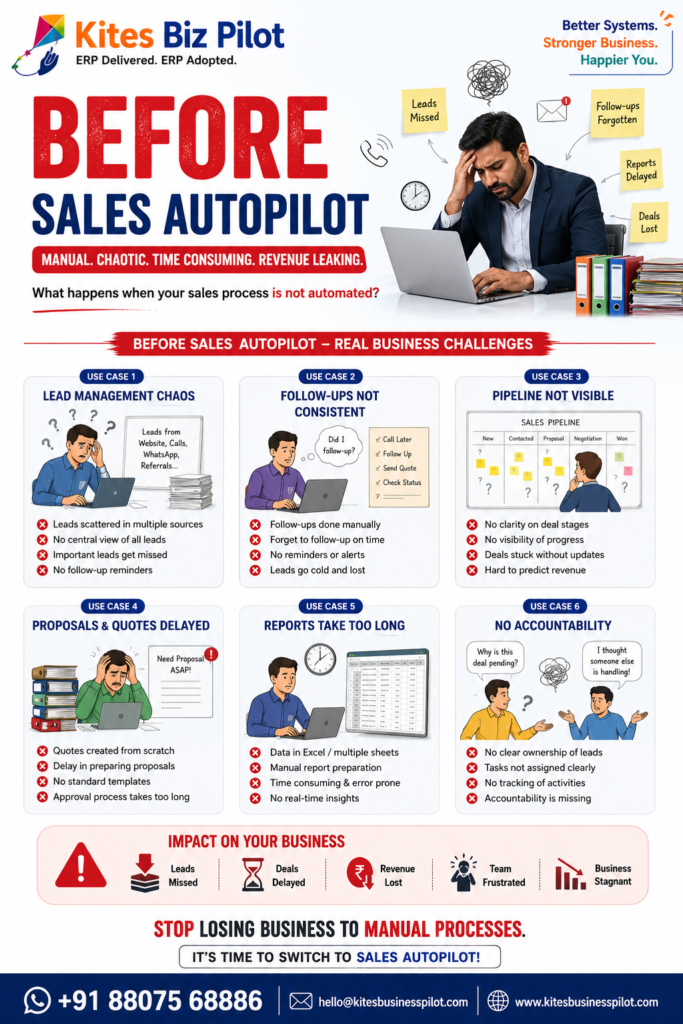
BEFORE SALES AUTOPILOT
What sales chaos looks like
1. Leads coming from everywhere
Website
WhatsApp
Phone calls
Instagram
Facebook
Referrals
Walk-ins
Everything comes from different channels.
Result?
No central tracking.
Some leads get ignored.
Some get forgotten forever.
2. Follow-ups depend on memory
Your sales team says:
“I’ll call tomorrow.”
Tomorrow becomes next week.
The customer buys from someone else.
3. Quotation delays
Customer asks for quotation.
Your team:
- Searches old templates
- Checks pricing manually
- Waits for approvals
- Sends late proposal
Customer moves on.
4. No pipeline visibility
You don’t know:
- Which leads are hot
- Which leads are cold
- Which deals are closing
- Which salesperson is performing
Everything is confusion.
5. Manual reporting
Excel sheets
WhatsApp updates
Phone calls
Verbal updates
By the time report reaches you, it’s already outdated.
6. Business owner stress
This is the biggest hidden problem.
You miss:
- Family time
- Weekends
- Peace of mind
Because sales depends completely on you.
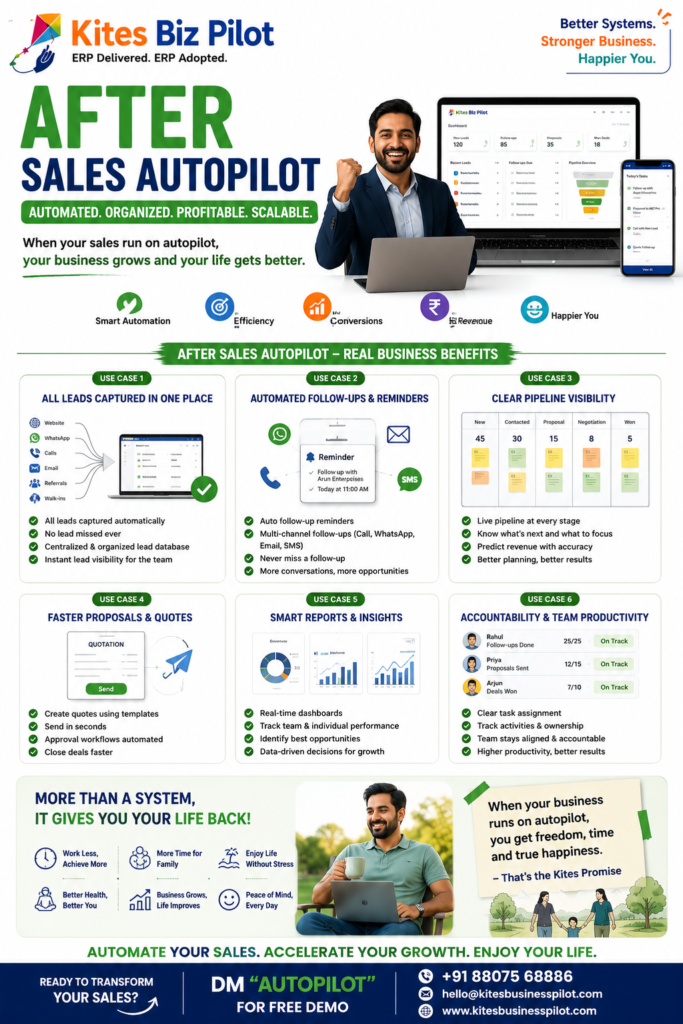
AFTER SALES AUTOPILOT
What happens when systems take over
This is where Kites Biz Pilot Sales Autopilot changes everything.
1. All leads captured automatically
Website enquiry? Captured.
WhatsApp lead? Captured.
Phone enquiry? Captured.
Referral lead? Captured.
Everything goes into one system.
No missed opportunities.
2. Automatic follow-up reminders
The system reminds your team:
- Call customer
- Send proposal
- Follow up payment
- Reconnect leads
No lead gets forgotten.
3. Faster quotations
Pre-built templates
Quick approvals
Instant quotation generation
Customers receive proposals faster.
4. Clear sales pipeline
You can instantly track:
New Leads → Follow-up → Proposal → Negotiation → Won
Everything becomes visible.
5. Real-time reports
See:
- Sales team performance
- Conversion rates
- Revenue forecast
- Pending deals
No waiting for Excel reports.
6. More life balance
This is the real transformation.
You stop becoming:
Owner + Sales Manager + Follow-up executive
And start becoming:
CEO
You get:
✔ More family time
✔ Less stress
✔ Better focus
✔ Predictable growth
Real Business Transformation
Before:
Sales depends on people
After:
Sales runs on systems
Before:
Chaos
After:
Clarity
Before:
Missed leads
After:
More closures
Before:
Stress
After:
Freedom
Who needs Sales Autopilot?
- Construction companies
- Manufacturers
- Traders
- Service businesses
- Schools
- SME founders
- Growing startups
Final Thought
Your business should grow because of systems.
Not because you are working 18 hours daily.
Automate your sales.
Accelerate your growth.
Enjoy your life.
Want a free demo?
DM AUTOPILOT
📞 +91 88075 68886
📧 hello@kitesbusinesspilot.com
🌐 www.kitesbusinesspilot.com
Kites Biz Pilot
Better Systems. Stronger Business. Happier You.
Implementing an ERP system is a big step for any SME.
However, many businesses fail not because of the software—but because they are not prepared.
Before you invest in ERP, you must ask:
👉 Is your business truly ready?
This guide explains a step-by-step ERP readiness roadmap, along with real SME case scenarios, to help you avoid costly mistakes and achieve better ROI.
🧩 Why ERP Readiness Matters
Many SME owners believe ERP will solve all problems instantly.
However, without preparation:
- Implementation gets delayed
- Costs increase
- Teams resist change
- Data becomes unreliable
👉 As a result, ERP becomes a burden instead of a solution.
📍 Step-by-Step ERP Readiness Roadmap
1️⃣ Define Your Business Goals
Start with clarity.
- Why do you need ERP?
- What problems are you solving?
- What does success look like?
📌 Case Insight:
A trading company implemented ERP without clear goals.
Later, they realized they only needed inventory control and cash visibility, not full automation.
👉 Lesson: Clarity reduces cost and confusion.
2️⃣ Map Your Current Processes
Understand how your business runs today:
- Sales
- Purchasing
- Inventory
- Accounting
📌 Case Insight:
A distributor had three different systems for sales, stock, and accounts.
Because of this, data mismatches were frequent.
👉 Lesson: Disconnected systems create inefficiency.
3️⃣ Design Future Processes
Now simplify.
- Remove unnecessary steps
- Standardize workflows
- Plan automation
📌 Case Insight:
A manufacturing SME reduced manual approvals and automated purchase flow.
This improved speed and reduced errors.
👉 Lesson: ERP works best with simple processes.
4️⃣ Build the Right Internal Team
ERP is not just IT—it’s a business project.
- Assign a project owner
- Identify decision-makers
- Involve key users
📌 Case Insight:
One company delayed ERP by 6 months due to unclear ownership.
👉 Lesson: No owner = no progress.
5️⃣ Clean Your Data
Your ERP is only as good as your data.
- Customer records
- Product details
- Financial data
📌 Case Insight:
A company migrated incorrect stock data, leading to wrong inventory reports.
👉 Lesson: Garbage in = Garbage out.
6️⃣ Set Policies & Rules
Define how your system will operate:
- Pricing rules
- Approval workflows
- Accounting standards
👉 This ensures discipline across teams.
7️⃣ Define Budget & Timeline
Be realistic.
- Implementation cost
- Training time
- Internal effort
📌 Case Insight:
An SME chose the cheapest ERP vendor and later spent double fixing issues.
👉 Lesson: Cheap decisions become expensive later.
8️⃣ Choose the Right ERP Partner
Your partner matters more than the software.
- Experience in SMEs
- Proven methodology
- Industry understanding
👉 A good partner ensures smoother adoption.
9️⃣ Prepare for Change
ERP success depends on people.
- Train your team
- Communicate clearly
- Handle resistance
👉 Adoption is key to success.
🔟 Start Small (Pilot Approach)
Don’t implement everything at once.
- Begin with key modules
- Test processes
- Scale gradually
📌 Case Insight:
A business started with inventory + finance.
Once stable, they expanded to CRM and operations.
👉 Lesson: Small start = Strong foundation.
⚠️ Common ERP Mistakes SMEs Must Avoid
❌ Poor data quality
❌ No ownership
❌ Over-customization
❌ Choosing based on price alone
👉 These are the biggest reasons ERP projects fail.
💡 What Leads to ERP Success?
Successful ERP implementation depends on:
✔ Clean and reliable data
✔ Strong internal team
✔ Structured processes
👉 Technology alone is not enough.
📈 Final Thought: ERP is a Business Decision, Not an IT Decision
ERP is not just software.
It is your business control system.
When implemented correctly, it gives:
- Real-time visibility
- Better decision-making
- Improved efficiency
- Scalable growth
🚀 Need Help with ERP Readiness?
Before you invest in ERP, understand your gaps.
👉 Get a Free ERP Readiness Assessment for SMEs
📞 +91 88075 68886
📧 hello@kitesbusinesspilot.com
🌐 www.kitesbusinesspilot.com
ERPforSME #ERPImplementation #BusinessAutomation #SMEGrowth #DigitalTransformation #Odoo #ERPIndia #BusinessSystems #EntrepreneurIndia #MSME
Growth feels good.
More orders.
More customers.
More revenue.
However, growth also brings pressure.
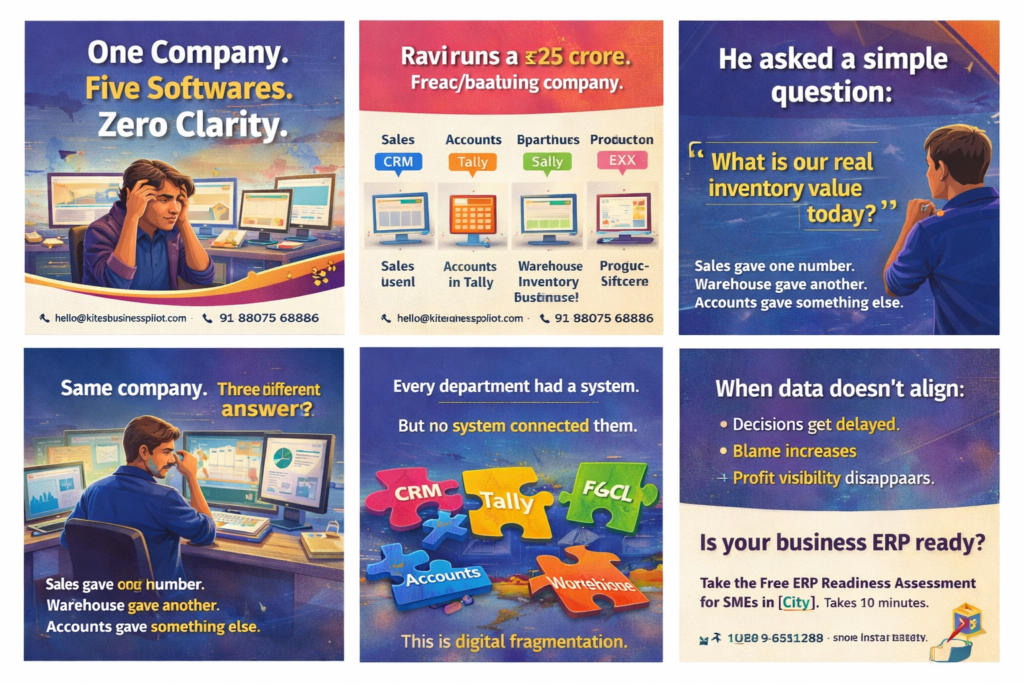
This is Ravi’s story. He runs a growing manufacturing and distribution company. His journey reflects what many SME owners experience when their systems stop keeping up.
If you are looking for ERP for SMEs, ERP implementation for manufacturing, or an ERP readiness assessment, this will sound familiar.
Day 1 – Confusion: Numbers Don’t Match
Ravi asked a simple question:
“What is our current inventory value?”
Sales shared one number.
The warehouse shared another.
Accounts had a different figure.
Everyone worked hard. Yet the numbers didn’t match.
The problem was not effort. The problem was disconnected software.
Sales used one system.
Accounts used another.
Inventory ran on separate software.
Production depended on Excel sheets.
Because these systems did not connect, data stayed scattered.
As a result, Ravi had no clear view of his business.
Day 2 – Conflict: The Blame Game Begins
Soon, customer orders were delayed.
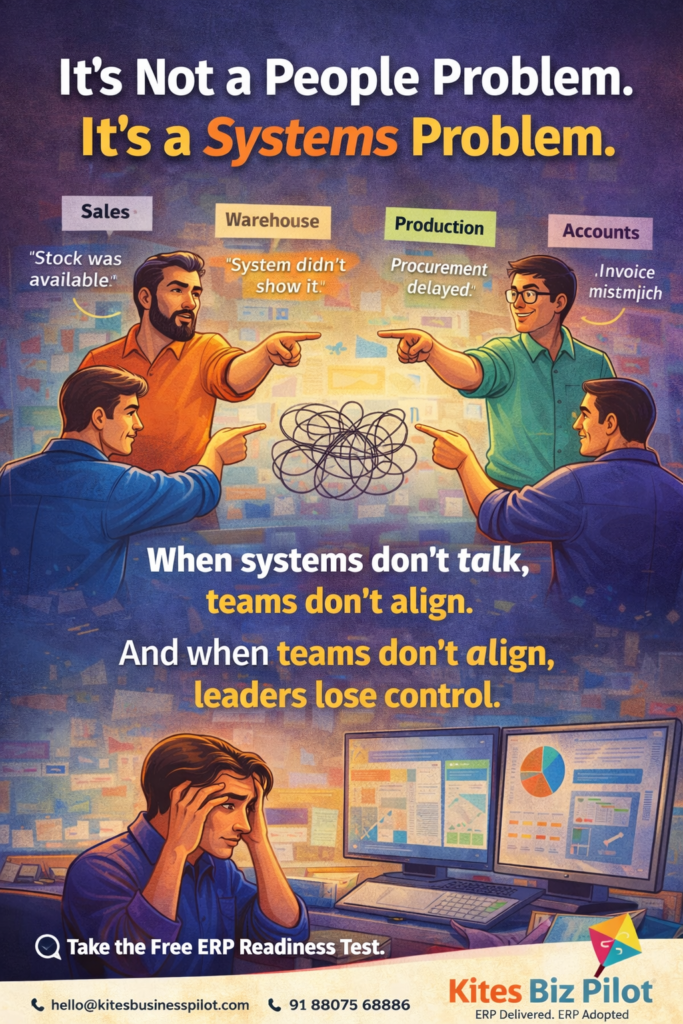
Sales said stock was available.
The warehouse said it was not updated.
Production blamed procurement.
Accounts blamed data mismatch.
Tension increased.
However, the issue was not poor teamwork. It was poor integration.
When systems do not talk to each other, teams cannot align. Therefore, confusion turns into conflict.
Over time, trust drops. Meetings become defensive. Leaders feel stuck.
Day 3 – Control Loss: Reports Take Too Long
Monthly review meetings became stressful.
It took four days to finalize one report.
First, sales data was collected.
Next, inventory numbers were corrected.
Then, finance adjusted entries.
Finally, a revised report was prepared.
By that time, the numbers were already old.
Delayed data leads to delayed decisions.
If your reports need multiple Excel files and repeated corrections, you do not have real-time control. Instead, you have manual patchwork.
This is common in growing SMEs without integrated ERP systems.
Day 4 – Scaling Risk: Expansion Creates Chaos
Ravi opened a second warehouse.
He expected growth. Instead, he faced new problems.
Inventory did not sync.
Stock transfers were unclear.
Accounts could not match stock movement.
Sales oversold products.
The business grew. However, the systems did not.
When companies expand without integrated software, complexity increases fast. Therefore, small gaps become big risks.
Scaling with disconnected tools is risky. It weakens the foundation of growth.
Day 5 – Clarity: Systems Finally Unite
After months of stress, Ravi made a decision.
He moved to an integrated ERP system.
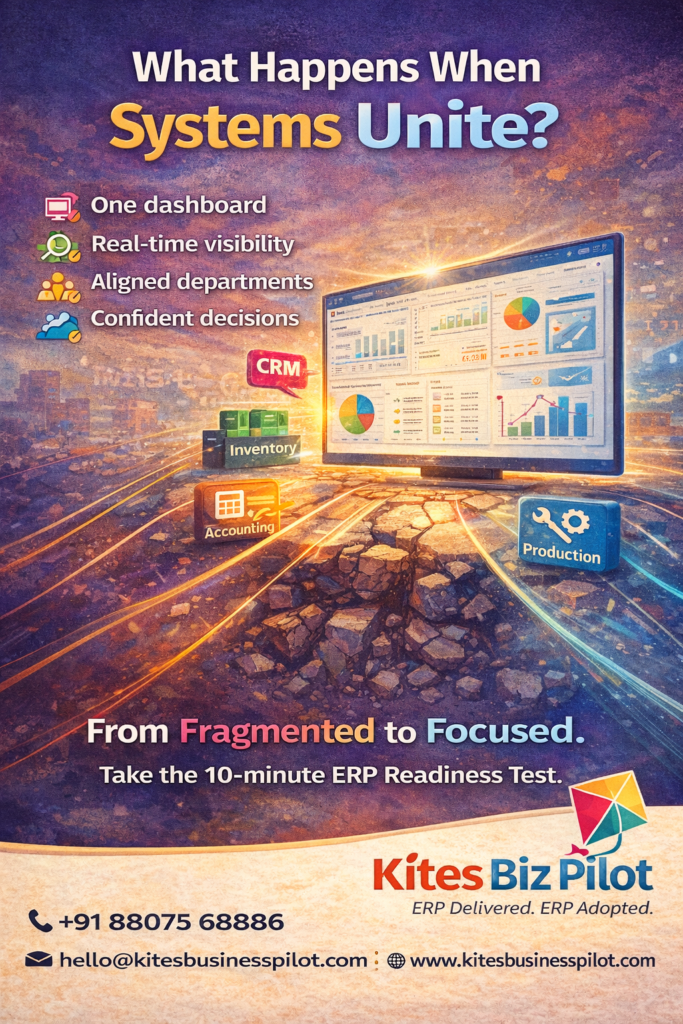
Sales, inventory, production, and finance now worked inside one platform.
The impact was clear.
There was one dashboard.
Data updated in real time.
Reports were instant.
Departments aligned naturally.
Meetings became shorter. Decisions became faster. Confidence returned.
ERP did not just change software. It changed visibility.
Why This Story Matters for SME Owners
Many growing businesses face the same pattern:
First comes confusion.
Then comes conflict.
After that comes loss of control.
Next comes scaling risk.
Finally, clarity comes only after integration.
Growth is not the problem.
Disconnected systems are.
How ERP Helps Manufacturing & Distribution SMEs
ERP for manufacturing and distribution SMEs brings everything into one system.
It helps you:
- Track inventory in real time
- Connect sales with stock
- Automate accounting entries
- Generate instant reports
- Manage multiple warehouses
- Improve decision-making
Because all departments use the same data, alignment improves automatically.
Are You Ready for ERP?
Before implementation, readiness matters.
An ERP readiness assessment helps you understand:
- Where data gaps exist
- Which processes need standardization
- Whether your team is prepared
- How scalable your current systems are
This step reduces risk and improves ERP success.
Final Thought
If your business feels busy but unclear, pause and evaluate.
If reporting feels slow, examine your systems.
If departments blame each other, look at integration.
ERP is not about complexity. It is about clarity.
When systems unite, leaders regain control.