
In today’s competitive market, business growth is not just about increasing sales.
It’s about building systems that run operations efficiently — with minimal manual intervention.
This is where ERP-powered Autopilot Systems transform the way businesses operate.
What is a Business Autopilot System?
A Business Autopilot System is a structured operational model where:
- Processes run automatically
- Reports generate in real-time
- Inventory updates instantly
- Financial data stays accurate
- Approvals follow predefined workflows
Instead of depending on individuals, the business depends on systems.
And the engine behind this automation?
An effectively implemented ERP system.
Why Traditional Businesses Struggle to Scale
Many growing businesses still rely on:
- Manual Excel tracking
- Separate software for accounts, inventory, and sales
- Delayed reporting
- Lack of real-time visibility
- Owner-dependent decision-making
This creates operational bottlenecks.
Without systemization, scaling becomes chaotic.
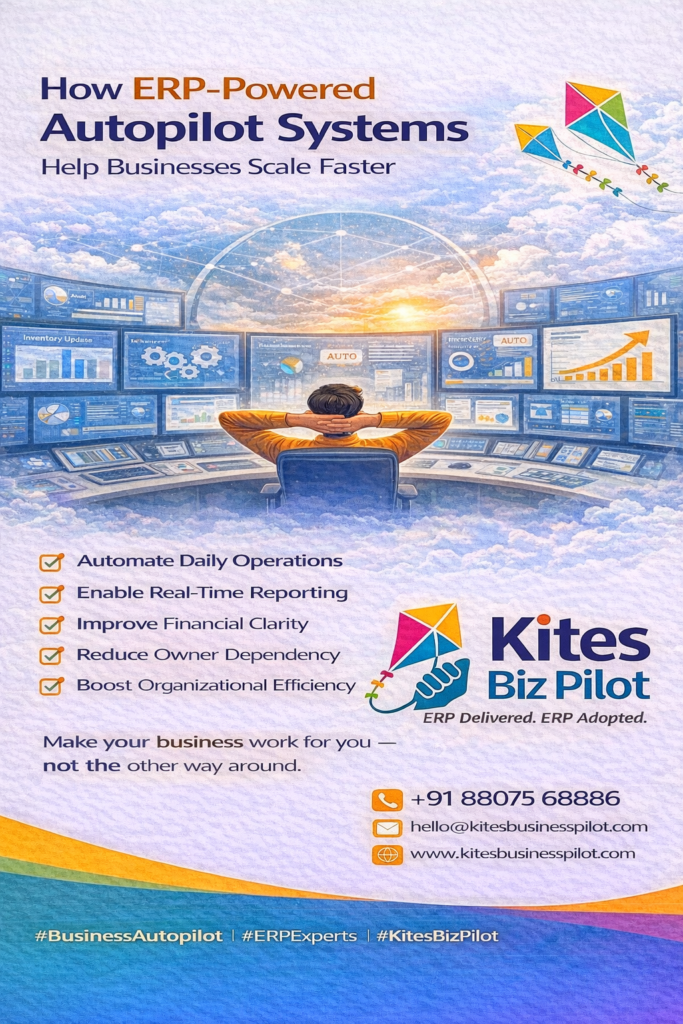
How ERP Creates an Autopilot Business Model
An ERP system integrates all departments into one centralized platform.
When implemented strategically, ERP enables:
1. Process Automation
Routine tasks like invoicing, stock updates, payroll, and purchase orders are automated.
2. Real-Time Visibility
Business owners get instant access to dashboards and performance reports.
3. Data Accuracy
No duplicate entries. No mismatched inventory. No financial confusion.
4. Accountability & Workflow Control
Defined approval hierarchies reduce errors and improve operational discipline.
5. Reduced Owner Dependency
The business can operate smoothly even without constant supervision.
This is what we call running your business on autopilot.
ERP Is Not Just Software — It’s a Control Tower
Many businesses fail in ERP adoption because they treat ERP as a software installation.
Successful automation requires:
- Business process mapping
- Proper module configuration
- Data migration accuracy
- Team training
- Post-implementation monitoring
ERP works only when implementation is done strategically.
The Business Benefits of ERP Autopilot Systems
Companies that adopt ERP-driven automation experience:
- Faster decision-making
- Improved operational efficiency
- Lower administrative costs
- Better cash flow control
- Higher productivity
- Scalable business structure
Most importantly, business owners gain clarity and control.
Who Needs ERP Autopilot Systems?
ERP-powered automation is ideal for:
- Manufacturing companies
- Trading businesses
- Multi-branch enterprises
- Growing SMEs
- Companies facing operational confusion
If your business is growing but feels unstructured, automation is no longer optional.
From Manual to Managed: The Future of Growing Businesses
Scaling without systems leads to stress.
Scaling with ERP leads to stability.
A well-designed Autopilot System allows businesses to:
- Focus on strategy
- Improve profitability
- Strengthen internal processes
- Prepare for long-term expansion
Automation is not about replacing people.
It’s about empowering them with structured systems.
Conclusion
In modern business, growth belongs to system-driven organizations.
ERP-powered Autopilot Systems provide the foundation for sustainable expansion.
If you want your business to run efficiently, transparently, and profitably — it’s time to move from manual operations to structured automation.
Systemize. Automate. Scale.